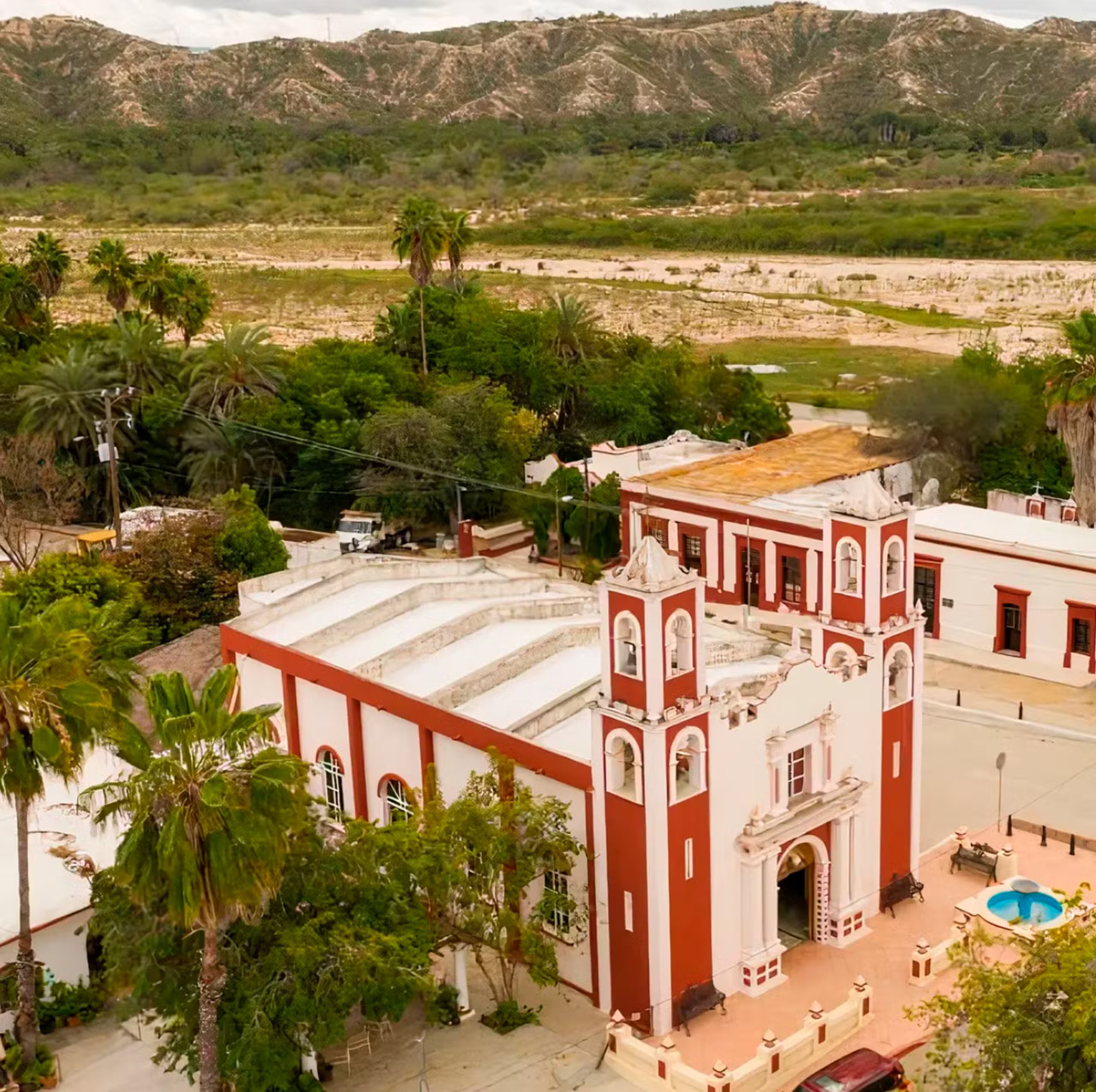
Misión Santiago de los Coras is the Jesuit mission that gave our town its name. It was founded in 1724 by the Italian Jesuit Ignacio María Nápoli at a native settlement called Aiñiní, about 40 km north of San José del Cabo. Nothing of the original Jesuit buildings stands today, but the story is still written into Santiago: the name, the layout of the valley around the water, the church you'll see from the road.
We live a few minutes from town, beside the lagoon at La Laguna, and the mission is one of the first things we suggest to anyone curious about what this valley was before Highway 1 ran through it.
When was the mission founded?
The mission was founded in 1724. You'll also see 1721 attached to it, and both dates have a reason. Nápoli wrote his account of the Cora people of the region, his Relación, on September 20, 1721, and some lists of Baja California missions date Santiago from that first effort. The mission itself was established at Aiñiní in 1724, paid for by two patrons in Mexico City: the Marqués de Villapuente de la Peña and his wife, the Marquesa de las Torres de Rada.
Who were the Coras?
The Coras were the native people of this part of the Cape Region, and the mission took part of its name from them. Historians haven't fully agreed on who they were. An older reading, from the anthropologist William C. Massey in 1949, placed them among the Guaycura-speaking groups. More recent work favors the view that "Cora" was simply another name for the Pericú, the people who lived across the southern tip of the peninsula.
What happened in the Pericú Revolt of 1734?
Santiago was the first mission struck in the Pericú Revolt of 1734. Its missionary, Lorenzo José Carranco, was killed and the mission buildings were sacked. The uprising spread across the Cape missions that year. Rebuilding at Santiago began in 1734, the same year as the attack.
It's a hard chapter and we don't soften it when guests ask. If you walk through town with that date in mind, the quiet streets read differently.
Who served there after the revolt?
One name worth knowing is Ignacio Tirsch, a Bohemian Jesuit who was the resident missionary at Santiago from 1763 to 1768. His time there ended with the expulsion of the Jesuits from Spanish territories, after which the Baja California missions passed to other orders.
When was the mission abandoned?
The mission was abandoned in 1795, during the Dominican period. The people still living at the mission were moved to San José del Cabo, and Santiago carried on as a ranching and farming town in the valley.
What can you see in Santiago today?
You'll see a later church, not the Jesuit original. Its red-and-white walls stand out against the farmland and the Sierra de la Laguna behind, and from above it's easy to understand why a mission was put here: water, palms and planted fields in the middle of dry hills. The setting is what's survived best, and it's the same green valley we look onto from the lagoon and oasis.
Go in the morning or late afternoon. The light is softer, the heat is lower, and the town is at its most local. Santiago runs mostly on cash, so carry pesos for a snack or a coffee in town; we're a cash-free hotel ourselves, which surprises people.
How do you visit from Los Cabos?
Drive Highway 1 north from San José del Cabo for about 50 minutes and you're in the Santiago area. From Los Cabos International Airport (SJD) it's roughly an hour. If you're staying with us, the simplest way is our Explore and Discover outing: a guided tour of about two hours, led by locals, through the town and its mission and out into the quiet around it. Healthy snacks and drinks come with it. Book it with our concierge, who's at the desk every day from 7:30 am to 11:30 pm.
Pair it with something slower. A mission walk in the late afternoon, then sunset back at the lagoon, is one of our favorite days to suggest. You may spot herons or hawks from your terrace this time of day.
A short timeline
| Year | What happened |
|---|---|
| 1721 | Ignacio María Nápoli writes his Relación on the Cora people (September 20) |
| 1724 | Mission founded at Aiñiní, about 40 km north of San José del Cabo |
| 1734 | First mission struck in the Pericú Revolt; missionary Lorenzo José Carranco killed; rebuilding begins |
| 1763-1768 | Ignacio Tirsch serves as resident missionary |
| 1795 | Mission abandoned; remaining residents moved to San José del Cabo |